

Yamaha TX802
The Yamaha TX-802 is basically a keyless rackversion of the classic Yamaha DX7 II. It’s a FM synthesizer and it’s sharp digital sounds are very distinctive and recognizable.
When the original DX7 was released in 1983, FM synthesis was a new type of synthesis. It had no filters like analog synths and had a very different sonic character. The sound was cold, clean, and bright. Best suited for percussive sounds and metallic textures. Unfortunately FM synthesis was far too complex and mathematical for most musicians to grasp, so most were limited to using the presets, and the true potential of FM synthesis was seldom explored. Today, however there are many great software editors with large working surfaces, showing the physicality of the envelopes and carriers, which makes it much easier to understand and work with.
I think the FM sound blends very well with analogs sounds, and especially with really warm pads like those from the Roland JD-800/990.
Audio samples:
DX A short multitrack.
Afternoons In Utopia Toy Piano with pad sound.
Jungle Nice percussive multisound.
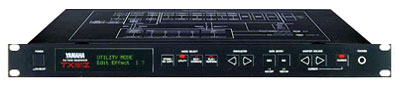
Yamaha TX81Z
The Yamaha TX-81Z is a 4-operator FM synth. Simpler than the DX7/TX802 due to fewer numbers of operators, frequency ratios and algorithms. However that makes it much easier to program and understand.
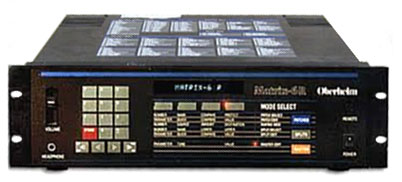
Oberheim Matrix 6R
The Oberheim Matrix 6R is a rack version of the Matrix 6. It’s analog but has digital envelopes, LFO’s and modulation. I’ve read several places on the Internet, that the Matrix 6 is a cheap way of getting the coveted sound of the classic big Oberheim’s (OB-X, OBXa and OB-8). That’s not true. They sound nothing alike. It would be the equivalent to comparing the Roland Jupiter 8 and the Roland Alpha Juno’s. They are a world apart.
I find the filter of the Matrix 6 a bit dull sounding and without the nuance of the earlier Oberheim synths. A very open filter setting will leave the sound sharp and digital sounding and a relative closed filter will leave the sound muffled. In fact here the dissimilarities with the classic Oberheim’s become painfully obvious, as they are famous for their silky soft and warm pads at low filter settings. The digital envelopes of the Matrix 6 are also somewhat slow.
The matrix 6 has an advanced matrix modulation system which allows for complex sound creation. You can route just about anything to anything, like on a modular system. I especially enjoy experimenting with the LFO and routing it to waveshape, filter frequency, resonance or another LFO. Anything’s possible.
Despite all of its shortcomings, it’s actually quite a nice synthesizer. Surprisingly I find it best at soft ethereal sounds with bell and piano-like timbres. Sometimes it can almost sound like a Yamaha DX-7 (FM synthesis). It also does brass sounds and filtersweeps quite well. Forget about programming a good bass sound though. It’s decent at best.
The Matrix 6R was later released in a 1 rack unit, the Matrix 1000, with 1000 presets. However the Matrix 1000 is only programmable via a PC/MAC editor and is monotimbral with only a mono output. The Matrix 1000 is also said to sound slightly thinner than the Matrix 6 due to different voice chips and clocking of the oscillators. Lastly the Matrix 6 responds much faster than the Matrix 1000 with external midi controllers.
Audio samples:
Dreamy synths Multitrack with all Oberheim Matix-6R sounds.
Echoes Antarctica A short multitrack based on the Vangelis track
Oberheim A short multitrack
New Age A short new agey multitrack
Ich ruf zu dir, Herr Jesu Christ J.S. Bach organ piece
Nice sound Playing one of the good sounds from the bank
Brass Thick sounding brass sound. Not that far from Vangelis’ CS-80 signature sound.

Roland JD-990
The Roland D-990 is more than just a rackversion of the Roland JD-800 keyboard. It has many more waveforms and features like Oscillator-Sync, Ring-Modulation and Frequency Cross Modulation. Like the JD-800 it has a warm filter with low, high and band-pass modes. The filters can be structured in different settings, so the tones can interact with eachothers filters. The JD-990 also features comprehensive effects processing and a 3-band parametric EQ.
For expansion it’s possible to install SR-JV80 expansion cards (primarily made for the Roland JV synths. In this unit the ‘Vintage Synth’ card (programmed especially for the JD-990) is installed.
The JD-990 can be controlled by the knobs and sliders on the JD-800, but it has a nice big display which makes editing fairly easy and clear. You can actually see the shapes of envelopes, LFO’s and filter-slopes which is very helpful.
Audio samples:
Tangerine A beautiful preset.
Twinkling String Another great preset.
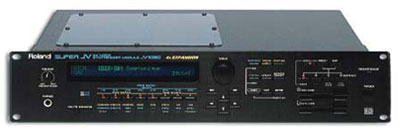
Roland JV-1080
The Roland 1080 is an old sample player like the Korg Triton. It’s a classic amongst romplers. There are plenty of expansion boards around to expand the soundbanks. Even though it’s a bit outdated by now, the sounds are still very usable and it still gets plenty of use.
The JV-1080 it not as programmable, warm or characterful as the JD-900, but is more of an “all sounds” sample player.
I have had a number of the expansion card installed. One of my favorites is the ‘Session’ expansion card. Despite the fact that I have several new massive GB samples of various pianos, I tend to just use this whenever I need a piano sound. It’s simple and really has a nice ring to it. I kinda like the anonymity of it. There are also some nice samples of nylon guitars and stratocasters on this card. Very useful. Good samples doesn’t need to be large GB files.
Audio samples:
Für Elise A multitrack using the piano from the ‘Sessions’ expansion card.
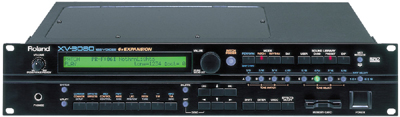
Roland JV-3080
The Roland JV-3080 is the successor to the JV-1080 released in 2000. It has far more internal memory, patches and polyphony than its predecessor. It has all the old classic waveforms from the JV-1080, plus a lot of new waveforms including some from the JD-990. It’s a powerful rompler with a lot of character and usability.

Roland MKS-50
The Roland MKS-50 is a rack version of the Roland Alpha Juno II synthesizer. It’s analog but has digitally controlled envelopes. It’s not quite as warm and powerful as the earlier Roland Juno synthesizers. The envelopes aren’t especially fast and the filter is a bit thin sounding. Still it’s a very useful synthesizer with a clear analog character. It also has some interesting waveforms in addition to the regular ones. The MKS-50 is a joy to program if you have the optional programmer: The Roland PG-300. Otherwise it’s really not.
The MKS-50 and PG-300 are no longer in the Antilles arsenal.
Audio samples:
MKS-50 A multitrack of MKS sounds (All except the chords which is JD-800)
MKS Electric Piano Great chorussed Electric Piano sound.

Novation Bass Station rack
A rack version of the small Bass Station keyboard. The Bass Station is a genuine monophonic analog synthesizer in a small box. Despite the name, it’s quite capable at other things than bass. It sounds like an old Roland synth.

Novation Drum Station
As the name suggests this is a drum synthesizer/drum machine. It emulates the sounds of the classic drum machines: Roland TR-808 and Roland TR-909. The Drum Station is a great and cheap way to get the real character of the original drum machines. Samples just don’t do them justice.
Audio samples:
TR-909 A TR-909 beat

Access Virus C
The Access Virus C is a modern virtual analog synthesizer. Virtual meaning that it’s not actually analog, but rather emulates the analog character. Perhaps it doesn’t sound quite as warm and organic as a real analog synthesizer, but its a great synthesizer and it goes far beyond the capabilities of an old analog synthesizer, both sound wise and feature wise. I consider the Virus a classic amongst virtual synths.
I think the Virus is one of the best Virtual Analog synthesizers ever produced. Its very powerful and has a huge array of sounds and modulation options. The Virus does about any type of analog and digital sound you’d wish for. Fortunately there’s plenty of knobs for the most important parameters, so programming is pretty straightforward. Access certainly did a great job here.
All though the original factory presets suggest that it’s primarily aimed for the Trance/Techno/Industrial marked, it’s quite perfect for synthpop or any other electronic genre for that matter. Some characterize the sound of the Virus as dark compared to other virtual analog synthesizers. I’m not sure I agree, but I love the sound and the Virus was quite the centerpiece of the Something New album. This version is the desktop version without keys.
The Virus C has been succeeded by the Virus TI and TI2 series synthesizers, adding more sounds, memory, effects, features and programmability. Still the Virus C remains a very powerful synthesizer.
Audio samples to come…